













Just past the China Zone on the Shanghai Ocean Aquarium’s nine-zone descent, the route detours from China’s rivers to the world’s largest rainforest system. The South America zone – built around the Amazon River and its freshwater giants – is where the aquarium swaps conservation storytelling for sheer scale, and its headline animal is the arapaima, one of the largest scaled bony freshwater fish on Earth. On our visits, this is the hall where visitors slow down and settle in front of the glass. This guide covers what the zone contains, how to read the arapaima tank, the Amazon stretch of the underwater tunnel, and the details worth pointing out to kids.
Principais conclusões
- Arapaima first – one of the largest scaled bony freshwater fish on Earth, and the zone’s giant.
- An Amazon tunnel stretch – the 155-meter underwater tunnel includes an Amazon River section.
- Second on the route – South America follows the China Zone on the single downhill walk.
- River, not reef – the hall reads as a tropical river system rather than a saltwater exhibit.
- Slow down here – the full visit runs 2–3 hours, and this hall rewards a deliberate stop.
Resposta rápida: the South America zone at the Shanghai Ocean Aquarium is built around the Amazon River, with the arapaima – one of the largest scaled bony freshwater fish on Earth – as its headline animal, plus an Amazon section inside the 155-meter tunnel. Standard admission covers it; adult e-tickets start a partir de US$ 23,23 no Trip.com.
The rainforest river
The aquarium’s zones are organized by region, and the South America zone is its tropical-river answer to the reef halls. The framing is the Amazon: slow-moving freshwater, a dense green backdrop, and fish built for size rather than color. After the China Zone’s conservation weight, the tonal shift is deliberate – this is the hall that shows off.
That point matters for expectations. Visitors who think of aquariums as saltwater exhibits sometimes underestimate a freshwater hall, and the Amazon is the rebuttal: the world’s greatest river system grows fish that rival anything in the ocean for presence. The zone sits second on the single downhill route, so it catches you while your attention is still fresh – one more argument for arriving near the 09:00 opening.
Arapaima, the giant
The arapaima is the reason to slow down. The aquarium describes it as one of the largest scaled bony freshwater fish on Earth, and even visitors who know the statistic tend to underestimate the silhouette until one cruises past the glass. Everything about the fish reads prehistoric – the heavy scaled body, the unhurried stroke – and it moves through the tank like it owns the place.
Reading the tank is easy once you know what to expect. The giants patrol rather than dart, and on our visits the best moments came when we stopped scanning and simply waited for a full pass at the glass. If a feeding session or guided talk is scheduled while you are nearby, the arapaima tank is the place to be standing.
De viagens reais: the arapaima tank taught our team the value of the ten-minute stop. First-timers walk past; the visitors who settle in front of the glass get the full-width cruise-by that makes the whole zone memorable.
The Amazon tunnel stretch
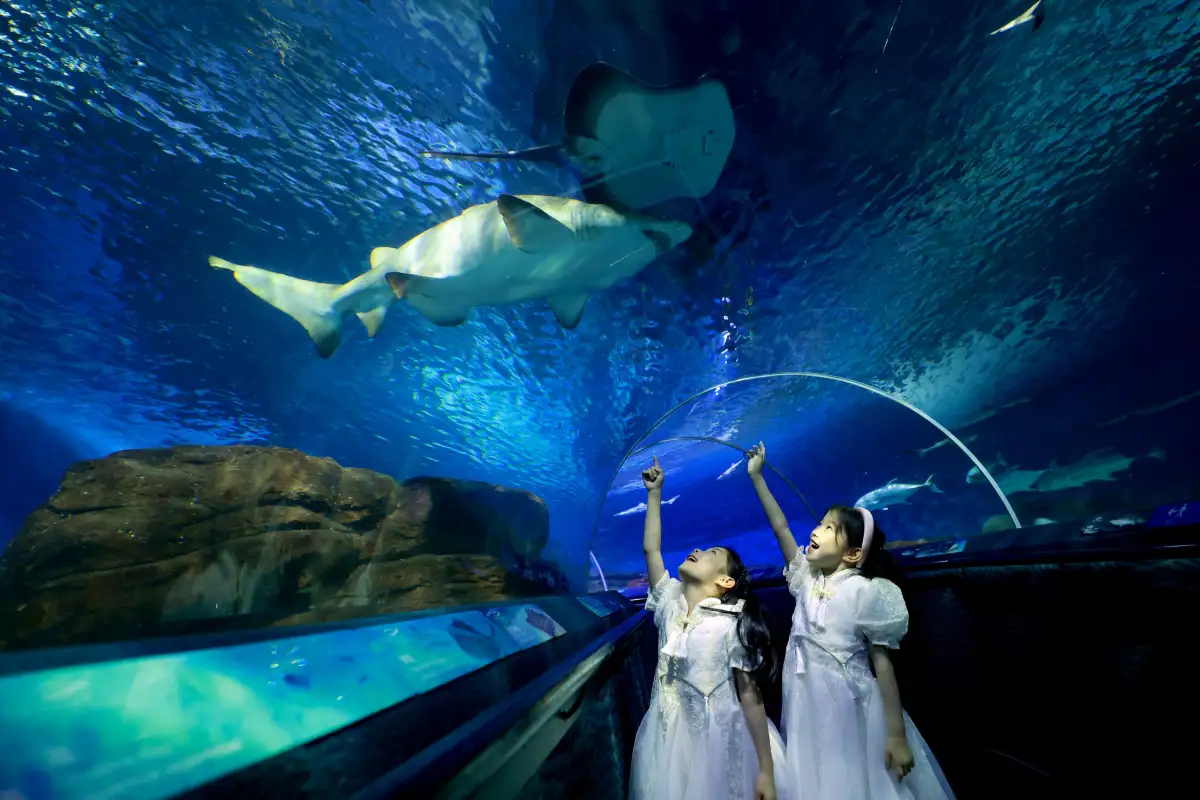
The aquarium’s signature 155-meter underwater tunnel is not a single biotope – its character changes along the length, and one of those stretches is the Amazon River section. Riding through it feels different from the Deep Ocean finale: the cast shifts from oceanic sharks and rays to the river’s freshwater species, and the atmosphere changes with them.
For orientation, the tunnel bookends the route’s water story. Its Deep Ocean section closes the visit with sand tiger sharks up to 3 meters, cownose rays in large schools and sardine tornado displays above the walkway, while the Amazon stretch carries the river theme inside the same continuous ride. Experiencing both in one visit – a river and an ocean in a single tunnel – is quietly one of the best arguments for this aquarium over a standard single-tank tunnel.
| Tunnel section | What you ride past |
|---|---|
| Amazon River section | Freshwater giants and rainforest-river species inside the tropical stretch of the ride. |
| Deep Ocean section | Sand tiger sharks up to 3 meters, schooling cownose rays and sardine tornado displays overhead. |
What else swims there
Beyond the arapaima, the zone holds the aquarium’s broader rainforest-river cast, and the honest advice is to enjoy it without needing a checklist. The labels in the hall do the naming work; our habit is to point out body shapes to travel companions – the long, the flat, the armored – rather than trying to name every fish on the move.
What we can say confidently is how the zone fits its neighbors. Australia’s endemic freshwater species follow next on the route, so the descent flows along a nice thematic current – great river systems of the world, one after another. If the freshwater theme hooks you, the China Zone’s Yangtze species at the top of the route complete the trilogy.
- Give the arapaima a full pass – ten quiet minutes beats a quick glance here.
- Check the feeding board – five interactive sessions run daily, with the day’s schedule posted at the entrance.
- Ride the tunnel with the hall fresh – the Amazon section lands better when the tank is still in your head.
The kids angle
For children, the South America zone usually ranks just behind the penguins and the seals, and the reason is size: these are fish that look like they could swallow a toddler’s imagination whole. The route’s stroller-friendly layout helps – the hall sits on the gentle downhill walk, so families can roll through at their own pace without stairs or backtracking.
Two extras stretch the stop. The aquarium runs five interactive feeding sessions daily, with guided talk sessions across zones and the day’s schedule posted at the entrance – catching one near this hall gives kids a diver to watch rather than only fish. And because the full visit runs 2–3 hours, the zone works as a natural midpoint pause before the colder halls later on the route.
Pacing tip: if younger children are flagging, take the break here. The zones lower on the descent move faster, and the tunnel finale rewards fresh attention more than it rewards endurance.
Perguntas frequentes
What is in the Amazon zone at Shanghai Ocean Aquarium?
The South America zone is built around the Amazon River, with the arapaima – one of the largest scaled bony freshwater fish on Earth – as its headline animal. The aquarium’s underwater tunnel also includes an Amazon River section within its 155 meters.
Is the arapaima really one of the largest freshwater fish?
Yes – the aquarium describes it as one of the largest scaled bony freshwater fish on Earth. In person the point lands: the fish patrols the tank with a presence nothing else in the hall matches.
Where does the South America zone sit on the route?
It is the second zone on the single downhill route, right after the China Zone and before Australia. The full walk runs through nine zones and ends at the underwater tunnel.
Can kids enjoy the Amazon zone without reading every sign?
Absolutely. The giant fish carry the hall on their own, and the five daily feeding sessions plus guided talk sessions give children movement and story to follow.
How much time should we give the South America zone?
The aquarium recommends 2–3 hours for the entire visit. We would give this zone a deliberate stop of its own – it is one of the halls where ten quiet minutes change the experience.
Lock your e-ticket and ride from river to ocean
From the Amazon to the open ocean in one visit
Instant-confirmation e-tickets with QR-code entry – no counter queue between you and the giants.
To keep planning: our sharks guide covers the tunnel’s oceanic finale in detail, and our nine-zone route guide shows exactly where South America sits in the descent. If you are deciding how long to budget, our timing guide breaks the visit into honest one-, two- and three-hour shapes, while our guia do melhor momento and Lujiazui itineraries handle the when and the what-next. Book the e-ticket, arrive early, and let the giants do the rest.
Fontes
- Arapaima description and the Amazon tunnel section per the official Shanghai Ocean Aquarium English-language site, checked October 2026.
- Nine-zone route structure, tunnel length and zone themes from the aquarium’s official exhibit materials.
- Hours (09:00–18:00), the 2–3 hour visit recommendation and e-ticket pricing from the Trip.com partner listing, checked October 2026.
- On-site verification by our editorial team during 2025–2026 visits.
