












The Shanghai Ocean Aquarium is engineered around a single idea: one gentle downhill walk through nine themed zones, from China’s rivers to the open ocean. That layout is the aquarium’s best feature and its least explained, because official materials list the zones without showing how they flow. On our 2025 and 2026 visits we walked the full descent more than once, and this guide lays out the route order zone by zone – the animals that anchor each hall, what to look for, and how to pace more than 450 species and 15,000-plus animals across the 2–3 hours the aquarium recommends.
Points clés à retenir
- Nine zones, one route – a single gentle downhill walk with no branches and no backtracking.
- China opens, Deep Ocean closes – from Yangtze species to the 155-meter tunnel in one descent.
- 450+ species, 15,000+ animals – across two pyramid buildings beside the Oriental Pearl Tower.
- 2 à 3 heures recommandées – the aquarium’s own guidance for the full nine-zone walk.
- Stroller-friendly throughout – the downhill route and the tunnel’s moving walkway carry families easily.
Réponse rapide : the nine zones run China, South America, Australia, Africa, Southeast Asia, Cold Water, Polar, Sea & Shore and Deep Ocean, in that order along one gentle downhill route. Standard admission covers the full walk – adult e-tickets start à partir de 23,23 $ sur Trip.com – and the aquarium recommends 2–3 hours for the visit.
How the route flows
The aquarium’s layout is a descending tour of the world’s water. You enter at the China Zone, walk a gentle downhill gradient through the great aquatic regions, and finish in the Deep Ocean zone’s 155-meter underwater tunnel – the longest of its kind in China – before surfacing near the exit. There are no branches and no reason to backtrack, which is why the visit works equally well for a first-timer and a third-timer.
Two design choices make the flow pleasant. The gradient is gentle enough that the aquarium presents the route as stroller-friendly, and the moving walkway inside the tunnel means even the finale asks nothing of your legs. The order also does quiet narrative work: rivers first, then tropical waters, then cold seas, then the open ocean – a depth-of-water arc that children absorb without being told.
Zones 1–3: China, South America, Australia
The China Zone is the world’s only dedicated hall for endemic Chinese aquatic species, and it opens the route with the heaviest conservation story in the building. The Chinese sturgeon – the “giant panda of the river” – headlines a cast that includes the Chinese sucker fish, the Yangtze alligator, the Chinese giant salamander and the Jinsha carp (Percocypris pingi), many of them nationally protected.
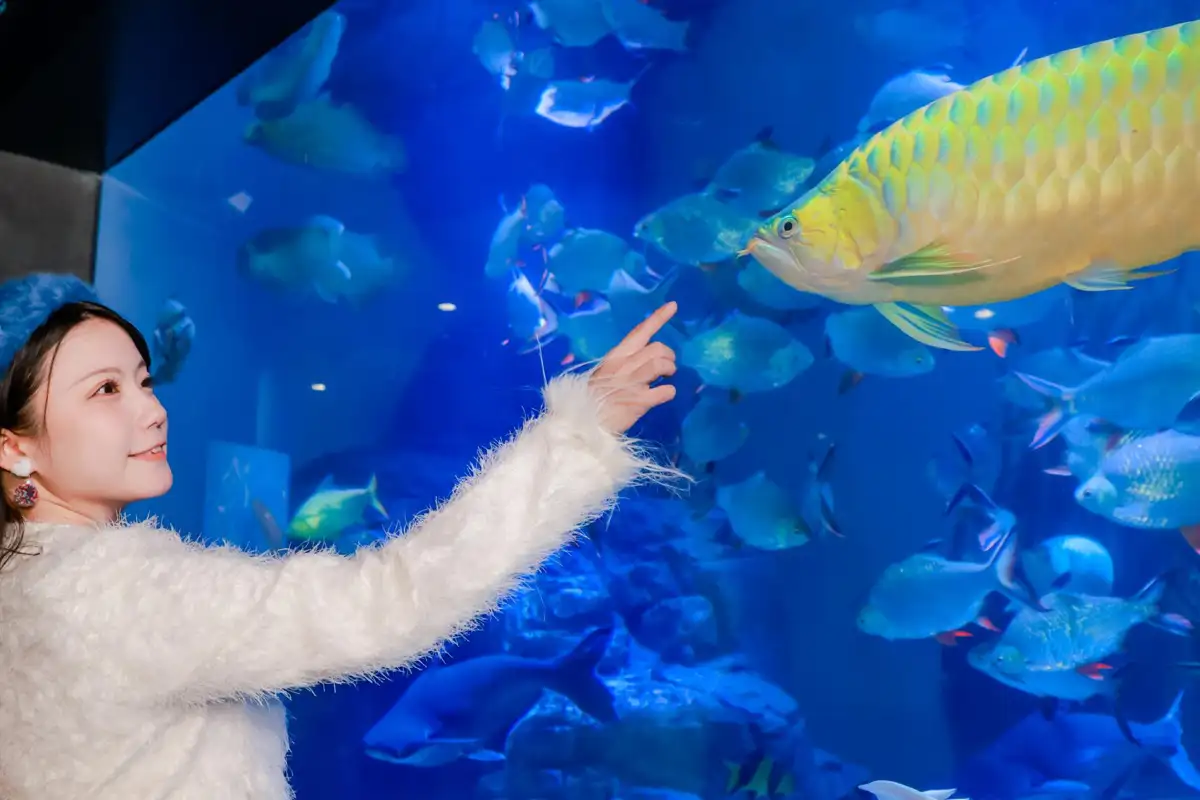
South America swaps conservation for scale. The arapaima, one of the largest scaled bony freshwater fish on Earth, anchors the Amazon-framed hall, and the underwater tunnel’s Amazon River section waits at the route’s end. Australia then closes the freshwater act with endemic species shaped by the continent’s long isolation – treat the hall as the palate cleanser between the Amazon’s giants and the African color ahead.
Zones 4–6: Africa, Southeast Asia, Cold Water
Africa is the color zone: cichlids from Lakes Victoria, Tanganyika and Malawi, three of the world’s great fish-evolution laboratories. It is a hall for lingering at one tank rather than touring many, because the variety inside a single display rewards patience.
Southeast Asia brings the tropical rainforest cast of the region’s rivers and shallows – the route’s most green, busy-water stretch, built for small-detail watching. Cold Water follows with the spotted seal hall, the first real crowd-pleaser stretch of the descent. The seals swim a semi-arc acrylic tunnel, and the species carries a national distinction: the spotted seal is the only seal that breeds within China, and its pups are born pure white.
Zones 7–9: Polar, Sea & Shore, Deep Ocean
The Polar zone is the Magellanic penguin hall – the “tuxedo”-plumaged birds from the coasts of Argentina, Chile and the Falkland Islands. Adults run about 70 centimeters and 4 kilograms, with black heads and a white band running from behind the eyes toward the throat, and they are best watched slowly rather than in passing.
Sea & Shore is the coastal biodiversity hall and the most variety-dense stretch of the route: cownose rays moving in large schools, green sea turtles with their natal-homing instincts, pot-bellied seahorses that reach up to 35 centimeters, and flashlight fish carrying bioluminescent organs under the eyes.
Deep Ocean is the finale: sand tiger sharks up to 3 meters, rays and schooling fish above the 155-meter tunnel’s moving walkway, and sardine tornado displays overhead. Ride it, then ride it again – the finale is the reward for the whole descent, and it is included in the same single admission.
The nine zones at a glance
For quick planning, here is the full descent in one table – the zone order, the signature animals, and what we would point a first-time visitor toward in each hall.
| Zone | Signature animals | What to look for |
|---|---|---|
| China | Chinese sturgeon, Chinese sucker fish, Yangtze alligator, Chinese giant salamander, Jinsha carp | The “giant panda of the river”; five endemic species found together nowhere else. |
| South America | Arapaima, Amazon river species | The arapaima’s full-width cruise past the glass. |
| Australia | Endemic freshwater species | Animals shaped by the continent’s isolation. |
| Africa | Cichlids from Lakes Victoria, Tanganyika and Malawi | Color and variety in a single tank – linger, don’t tour. |
| Southeast Asia | Tropical rainforest species | Small-detail watching in a green, busy-water hall. |
| Cold Water | Spotted seals | The semi-arc tunnel view; pups are born pure white. |
| Polar | Magellanic penguins | Black heads with a white band behind the eyes. |
| Sea & Shore | Green sea turtles, pot-bellied seahorses, cownose rays, flashlight fish | Seahorses up to 35 centimeters; flashlight-fish light organs. |
| Deep Ocean | Sand tiger sharks, rays, schooling fish | The 155-meter tunnel ride – take it twice. |
Signature animals here are anchors, not a census – each hall holds more than we list, across the aquarium’s 450-plus species. Use the table for orientation, then go deeper: our highlights guide picks out the twelve moments worth building a visit around.
Pacing the descent
The aquarium recommends 2–3 hours for the visit, and the nine-zone walk fits that honestly. A comfortable rule of thumb from our visits: keep the upper-route halls brisk, and spend the saved minutes on the seals, the penguins and the tunnel – the stretches where most visitors genuinely want more time.
- First hour. China through Southeast Asia at a steady pace, letting the zone order do the storytelling while your attention is fresh.
- Middle stretch. Slow down for Cold Water and Polar – seals and penguins reward patience, and the halls sit at the route’s natural midpoint.
- Final hour. Sea & Shore’s small-detail tanks, then the Deep Ocean tunnel – ideally with time for a second ride before you surface.
Mind the clock: the aquarium runs 09:00–18:00 daily but stops admitting visitors at 17:30. A full nine-zone walk is not a late-afternoon project – start early, or plan an honest shorter visit instead of a rushed one.
Feedings first: five interactive feeding sessions run daily and the day’s schedule is posted at the entrance. Slot one into your pacing plan before you start the descent, rather than hoping to bump into it.
Questions fréquemment posées
How many zones are in the Shanghai Ocean Aquarium?
Nine themed zones, walked in a fixed order on a single gentle downhill route: China, South America, Australia, Africa, Southeast Asia, Cold Water, Polar, Sea & Shore and Deep Ocean.
What is the route order at Shanghai Ocean Aquarium?
China opens the route and the Deep Ocean tunnel closes it. In between, the walk runs South America, Australia, Africa, Southeast Asia, Cold Water, Polar and Sea & Shore – rivers to tropical water to cold seas to open ocean.
How long does it take to see all nine zones?
The aquarium recommends 2–3 hours for the full visit. Families with young children and photographers should plan for the top of that range, and expect the seals, penguins and tunnel to absorb the extra time.
Is the whole route stroller and wheelchair friendly?
The route is a gentle downhill walk and the aquarium presents it as stroller-friendly; the tunnel is ridden on a moving walkway. For specific accessibility questions, contact the aquarium on +86-21-58779988 before your visit.
Which zone should I not skip?
The China Zone – it is the world’s only aquarium zone dedicated to endemic Chinese species – and the Deep Ocean tunnel that closes the route. Between those two bookends, all nine zones are one continuous walk anyway.
Book the e-ticket and start at the top
Nine zones, one downhill walk
Instant-confirmation e-tickets with QR-code entry – skip the counter queue and start the descent early.
From here, three guides extend this one: our underwater tunnel guide for the finale, our China Zone guide for the world’s-only hall at the top of the route, and our Amazon zone guide for the arapaima hall. If you would rather browse the aquarium as a whole first, our guide du visiteur collects hours, access and planning basics in one place. Pick your pace, book the e-ticket, and let the downhill walk do the rest.
Sources
- Zone count, route structure, species totals and tunnel facts per the official Shanghai Ocean Aquarium English-language site, checked October 2026.
- Zone-by-zone species descriptions (China Zone, South America, Africa, Southeast Asia, Cold Water, Polar, Sea & Shore, Deep Ocean) from the aquarium’s official exhibit materials.
- Hours, the 17:30 admission cutoff, the 2–3 hour recommendation and e-ticket pricing from the Trip.com partner listing, checked October 2026.
- Route order and zone highlights verified on-site by our editorial team during 2025–2026 visits.
